
Realistic Hair Hair science
What a follicle actually is, how a strand is timed, and why colour is not the same as curl.
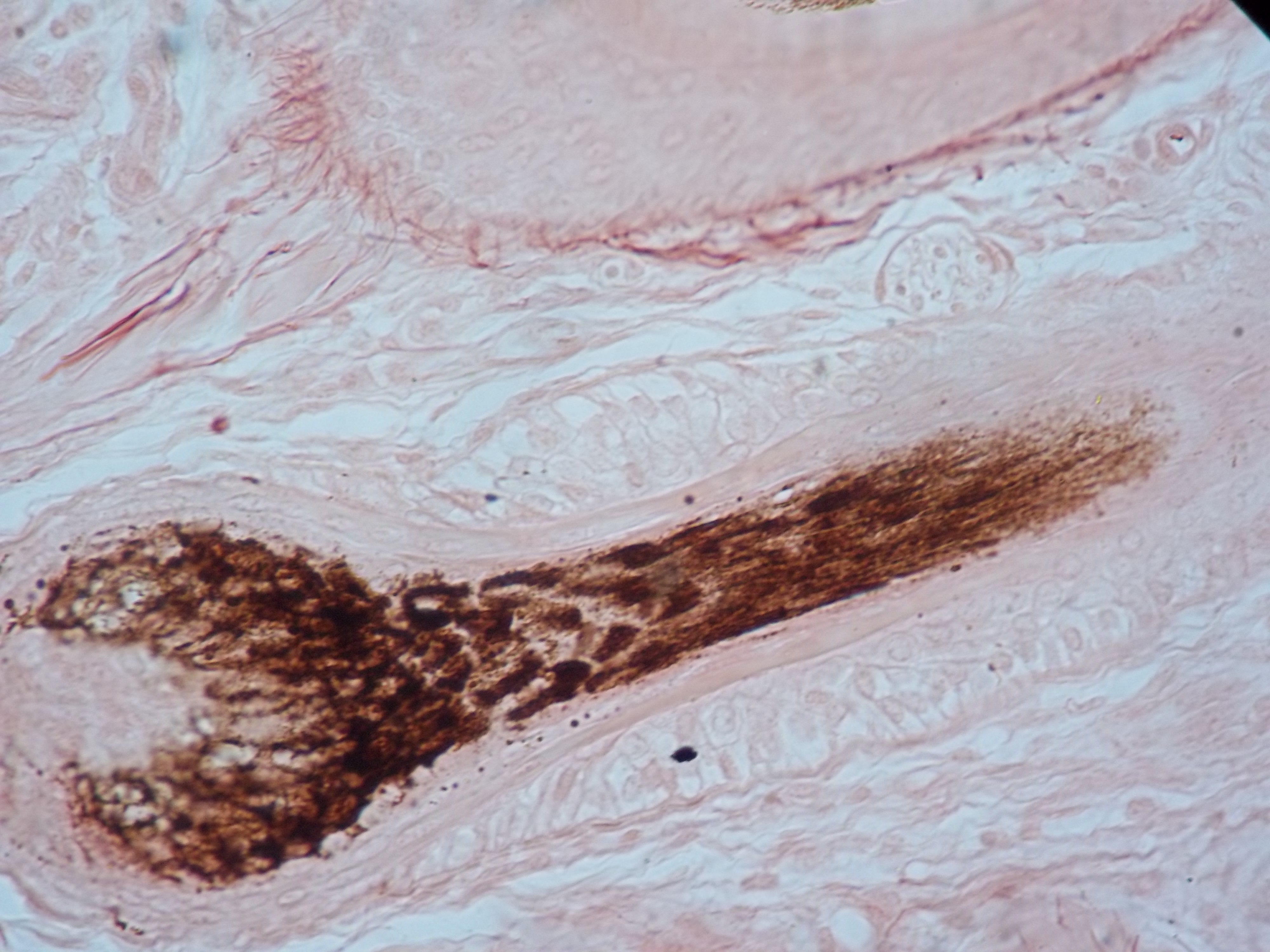
The Walker chart is a shop-window. Under it sits a mini-organ: the hair follicle, cycling through growth, regression, rest, and release. This hub collects the mechanism pages so a letter on types has somewhere to point when someone asks why.
Three pages, three jobs
- Follicle structure — shaft layers (cuticle, cortex, medulla), root sheaths, bulb, dermal papilla, sebaceous gland, arrector pili. TeachMeAnatomy and NCBI StatPearls “Physiology, Hair” are the backbone.
- Growth cycle — anagen, catagen, telogen, exogen; scalp timing of years / weeks / months; why shedding about 50–100 hairs can be ordinary. Natarelli et al., Journal of Clinical Medicine (2023), and NYU Langone’s patient explainer sit here.
- Colour and melanin — eumelanin versus pheomelanin, grey hair as a pigment-and-stem-cell story, and why pigment genes are not curl genes.
What this hub will not do
It will not diagnose alopecia, prescribe minoxidil, or rank ancestries. Koch, Tridico, Bernard, Shriver, and Jablonski (2020, American Journal of Human Biology) spent a review article telling anthropologists, forensic scientists, and cosmetic chemists they have been using incompatible vocabularies on the same fibre. We cite that warning instead of adding a fourth vocabulary.
How science and the chart should talk
De La Mettrie, Saint-Léger, Loussouarn, and Garcel (2007, Human Biology) measured hair shape in a worldwide sample and argued for continuous classes rather than four marketing families. Robbins’ Chemical and Physical Behavior of Human Hair remains the fibre-chemistry reference for cortex structure and curl. Use those when a Walker letter feels too coarse. Use the letter when you are standing in an aisle. The history of typing systems is the bridge.
Reading order
If you arrived from a care problem, start with structure (cuticle) then porosity. If you arrived from shedding anxiety, start with growth cycle. If you arrived from “why is my hair red and curly,” split the question: colour and the types hub are different axes.
Primary sources we actually used are listed again on sources. Britannica’s hair-anatomy article is the external deep link from the homepage for readers who want an encyclopedia page that is not this one.
Frequently Asked Questions
Quick answers to the most common questions.
Is the Walker chart scientific?
It is a stylist’s classification published in 1997. Scientific papers often prefer continuous curvature. Both can be useful if you do not confuse them.
Where should I start in this hub?
Structure if you care about products and porosity; growth cycle if you care about shedding; colour if you care about pigment.
Does this replace a dermatologist?
No. These pages summarise published anatomy. Sudden loss, pain, and scalp disease need a clinic.