
Realistic Hair Hair types 1A to 4C
Straight, wavy, curly, and coily families — and the letters that sit inside them.
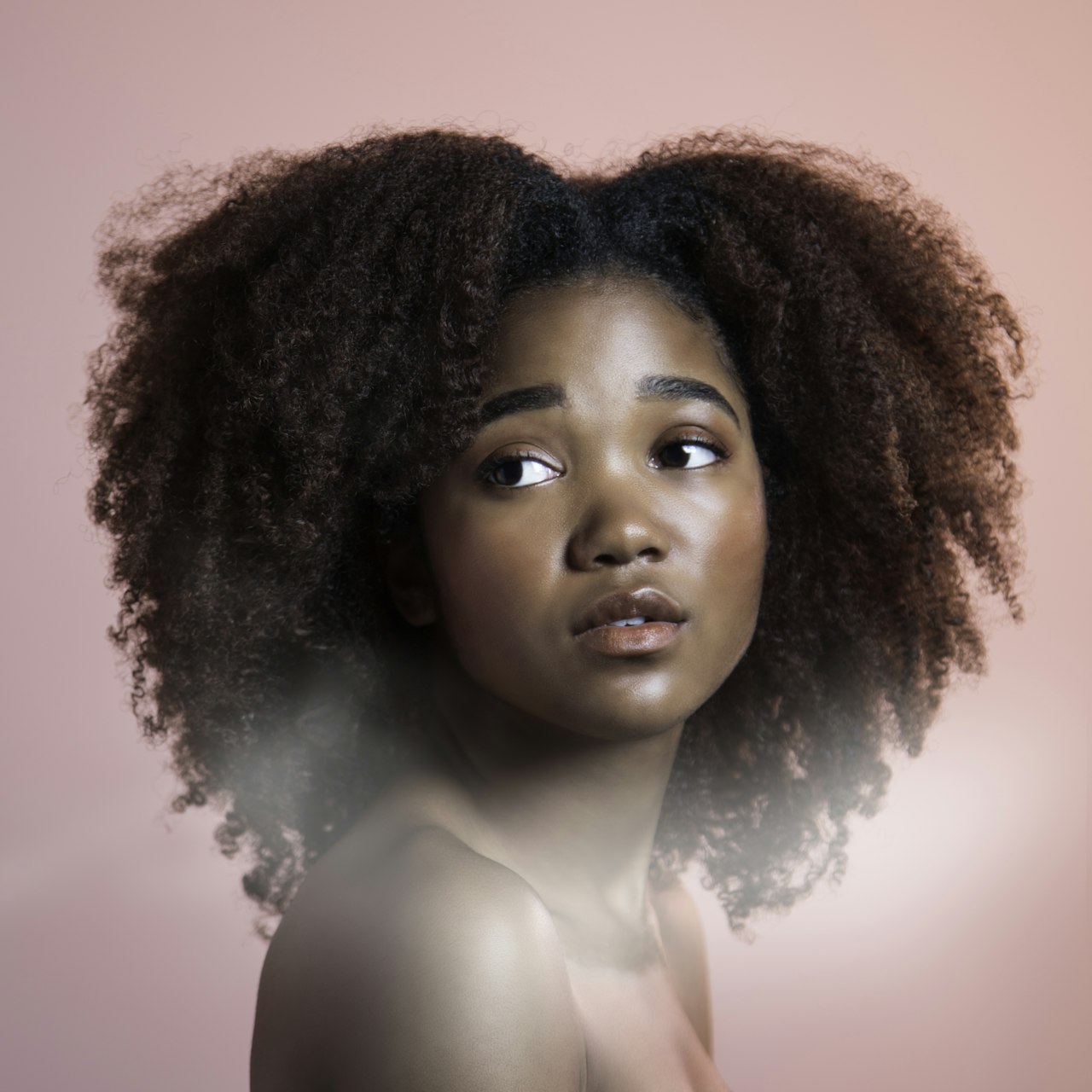
Hair type, in everyday language, means the shape a strand takes when it is clean, product-free, and fully air-dried. The chart most searchers mean is the Andre Walker Hair Typing System: four families numbered 1 through 4, each split into letters A, B, and C. Walker, long-time stylist for Oprah Winfrey, published the framework in Andre Talks Hair! (Simon & Schuster, 1997) to match clients to products. It is a styling shorthand, not a laboratory measurement of curvature, ellipticity, or follicle angle.
This hub is the map. Open a family page when you already know the number. Open the identify your hair type guide when you do not. Keep the hair type chart nearby so the wrap-test language (chalk, marker, pencil, crochet needle) has a table to land on.
The four families
Type 1 — straight. The shaft has no natural wave or loop. Sebum travels from the scalp to the ends with little interruption, so roots often look oily sooner than other families. Fine 1A strands refuse a curl; coarse 1C strands can look bone-straight and still frizz at the cuticle. Full notes live on straight hair.
Type 2 — wavy. An S-shape appears along the length. 2A waves sit close to the head and collapse under heavy cream. 2C waves can ringlet at the ends and get mistaken for loose curls. Humidity raises the cuticle on this family faster than on Type 1. See wavy hair.
Type 3 — curly. The strand forms a spiral or ringlet that springs back when stretched and released. Diameter is the usual letter test: sidewalk-chalk loops for 3A, marker-width ringlets for 3B, pencil-width corkscrews for 3C. Shine is often higher than on Type 4 because the cuticle still reflects light along a smoother arc. Read curly hair.
Type 4 — coily. Coils are small, springy, and often S- or Z-shaped. Shrinkage of 50 percent or more is common, so dry length is a poor proxy for wet length. 4A still shows a defined coil; 4B bends at sharper angles; 4C may look like a densely packed zigzag with no obvious loop until you stretch a single strand. Details: coily hair.
What the letters actually change
Inside each number, A is the loosest or finest expression and C is the tightest or coarsest. Walker’s original book did not freeze every subtype the internet now lists. Community charts and later product lines filled in 3C and 4C after 1997. Treat neighbouring letters as a gradient, not a wall. A head that is 3B at the crown and 3C at the nape is ordinary, not a failed test.
The letter is also not the same as strand thickness (fine, medium, coarse) or density (how many follicles per square centimetre). A fine 3A strand and a coarse 3A strand share a spiral diameter and need different product weight. Density changes how much product you need, not which family you are in.
Type is not porosity
Porosity is the cuticle’s willingness to take and lose water. Genetics set a baseline; bleach, heat, and UV raise it. A 4C coil can be low porosity (water beads, products sit) or high porosity (water rushes in and out). The porosity page and the porosity test guide exist so you do not buy “Type 3 products” that ignore the cuticle you actually have.
Scientific charts sitting beside Walker
De La Mettrie, Saint-Léger, Loussouarn, and Garcel (2007, Human Biology) measured hair shape worldwide and argued for a continuous classification rather than four marketing buckets. Koch, Tridico, Bernard, Shriver, and Jablonski (2020, American Journal of Human Biology) review how anthropology, forensics, and cosmetic science still talk past each other about the same fibre. Use Walker to shop and describe a wash-day. Use the science pages — follicle structure, growth cycle, colour and melanin — when you need mechanism.
How to use this hub
- Air-dry without product, then pick a family from the four links above.
- If two families both look plausible, read both and prefer the tighter pattern for care, as Clarice-style advice in later Walker charts often does.
- Run porosity as a second axis with the porosity checker.
- Only then open care by type. Product lists without a type and a porosity guess are noise.
The history of typing systems records what Walker published, what NaturallyCurly and later charts added, and why LOIS (pattern plus feel: wavy, curly, coily, zigzag, plus wiry or cottony) still has a following. This wiki keeps Walker as the search language because that is what people type, and it flags the chart’s limits on every family page.
Frequently Asked Questions
Quick answers to the most common questions.
How many hair types are there?
The popular chart has four families and twelve subtypes from 1A to 4C. Most heads mix two neighbouring subtypes. Scientific papers often prefer continuous curvature instead of twelve bins.
Who created the hair type chart?
Andre Walker published it in Andre Talks Hair! in 1997. Later community charts added subtypes. See the typing-systems history.
Can I have more than one hair type?
Yes. Crown, temples, and nape often differ. Identify the tightest pattern that still appears after an air-dry, then read both neighbouring pages in this hub.
Does hair type change?
Hormones, age, heat, and chemical services can change how a pattern shows. The follicle’s genetic programme is stable; the visible chart letter can still drift.