
Realistic Hair Hair follicle structure
A mini-organ from papilla to shaft, and why the cuticle decides porosity.
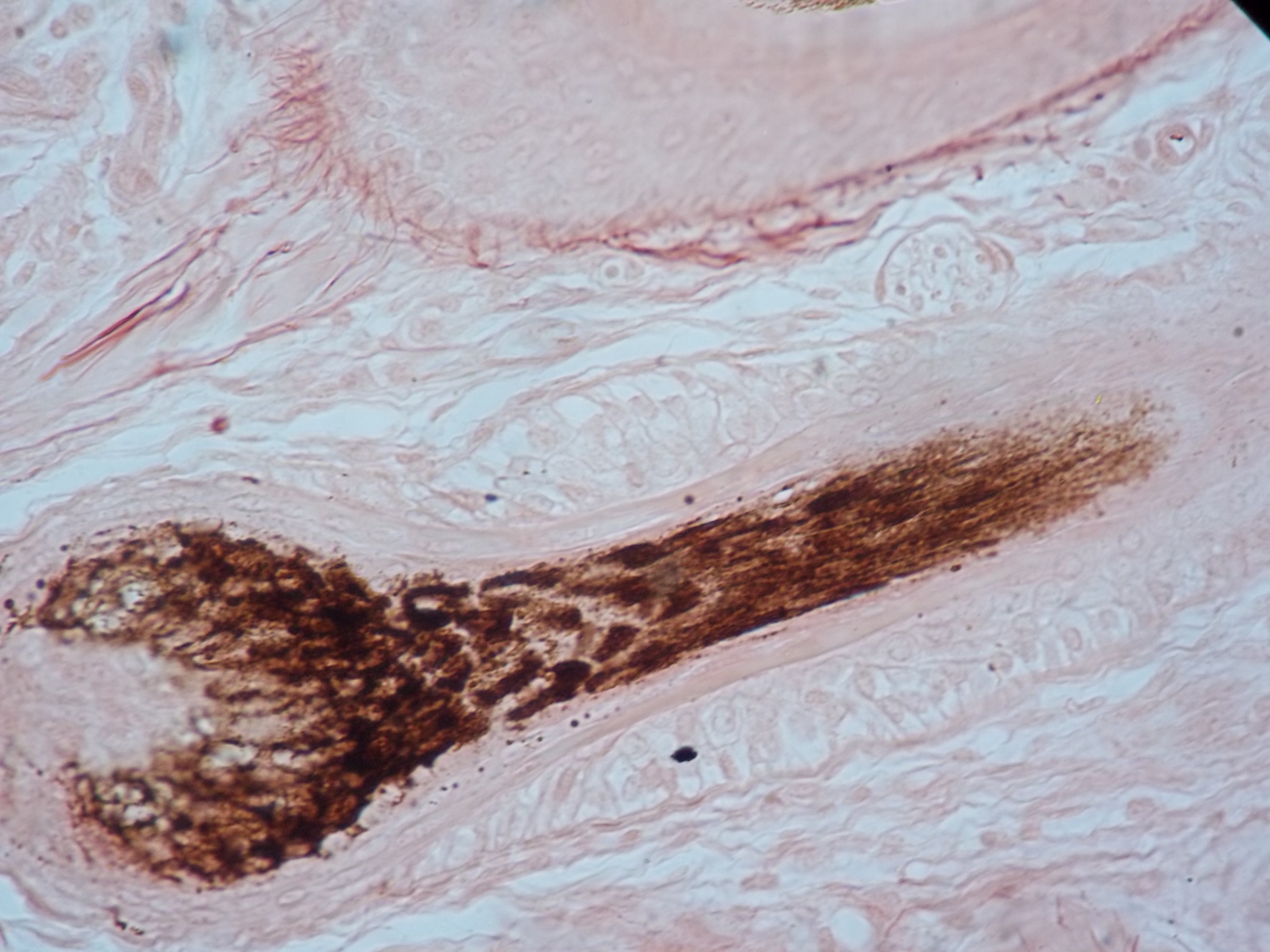
A visible hair is the cheap part. The living machinery is the follicle, an epidermal downgrowth into the dermis that builds a keratin fibre on a schedule. TeachMeAnatomy’s follicle page and NCBI StatPearls “Physiology, Hair” (updated 2023) describe the same stack from different teaching cultures. This page is the wiki’s anatomy layer so porosity and care have a cuticle to point at.
Shaft: medulla, cortex, cuticle
From the inside out:
- Medulla — a loose, sometimes air-filled core. Fine hairs often lack it. It is not a health score.
- Cortex — the bulk. Keratin filaments and melanin granules live here. Strength, bend, and colour are cortical jobs. Robbins and later reviews describe a more bilateral cortex in curly fibres and a more concentric arrangement in straighter ones.
- Cuticle — a single layer of flattened cells overlapping like shingles, pointing toward the tip. Intact shingles make shine and slow water. Raised or missing shingles are the physical meaning of high porosity.
When a conditioner “closes the cuticle,” it is a marketing sentence for flattening those shingles so they reflect light and leak less. It is not surgery.
Follicle wall
Around the growing shaft:
- Inner root sheath (Henle, Huxley, and a cuticle of its own) moulds the fibre as it rises, then disintegrates higher up.
- Outer root sheath continues with the epidermis.
- Connective-tissue sheath is the dermal wrap, with blood supply.
At the bottom, the bulb wraps the dermal papilla — a vascular knot that feeds the matrix cells that actually divide. If the papilla cannot talk to bulge stem cells after catagen, cycling stops. That sentence belongs to growth-cycle reviews (Natarelli et al., 2023) as much as to anatomy atlases.
Neighbours: sebum and goosebumps
Each follicle is a pilosebaceous unit with sebaceous glands dumping sebum into the canal. On Type 1 shafts that oil travels far; on Type 4 shafts it does not. The arrector pili muscle tugs the follicle into a pimple of skin we call a goosebump. Nerves around the follicle explain why a single hair can hurt when pulled.
Terminal, vellus, lanugo
Britannica’s hair article still gives the clean teaching split: lanugo (fetal), vellus (fine, unpigmented), terminal (the scalp hair this wiki mostly means). A “peach fuzz” hair is not a failed Type 1. It is a different follicle class.
Why shape happens
Follicle angle and ellipticity correlate with fibre curl. That is a population finding, not a reason to assign ethnicity from a photograph. De La Mettrie et al. (2007) quantified shape variability worldwide. This wiki’s types pages use Walker letters as search language on top of that biology.
How to use this page on a wash day
- Porosity talk is cuticle talk. After bleach, you have fewer intact shingles. Adjust using the porosity test.
- Protein talk is cortex talk. Mushy stretch is a cortex that has lost too much structure relative to water.
- Oil talk is sebum plus added lipids on a shaft that may or may not transport them.
Next: growth cycle for timing, colour for pigment, sources for the papers. The homepage trailer (a 3D layer walkthrough) is a different video from the mid-article embed here on purpose — one player per URL.
Frequently Asked Questions
Quick answers to the most common questions.
What part of hair is dead?
The visible shaft is keratinised and not living. The matrix in the bulb is the living factory. Conditioners coat the dead shaft; they do not resurrect it.
Where is porosity in this anatomy?
Mostly the cuticle. Gaps and cracks let water in and out. See porosity.
Does curly hair have a different follicle?
Curl correlates with a more elliptical follicle and a more bilateral cortex. It is a geometric trend, not a separate organ.
Why does oil never reach my ends?
On a coiled shaft, sebum has a longer, more interrupted path. That is geometry, which is why Type 4 routines add a seal. See coily hair.