
Realistic Hair Curly hair (Type 3)
Closed spirals and ringlets — the family defined by spring, not by an S-wave.
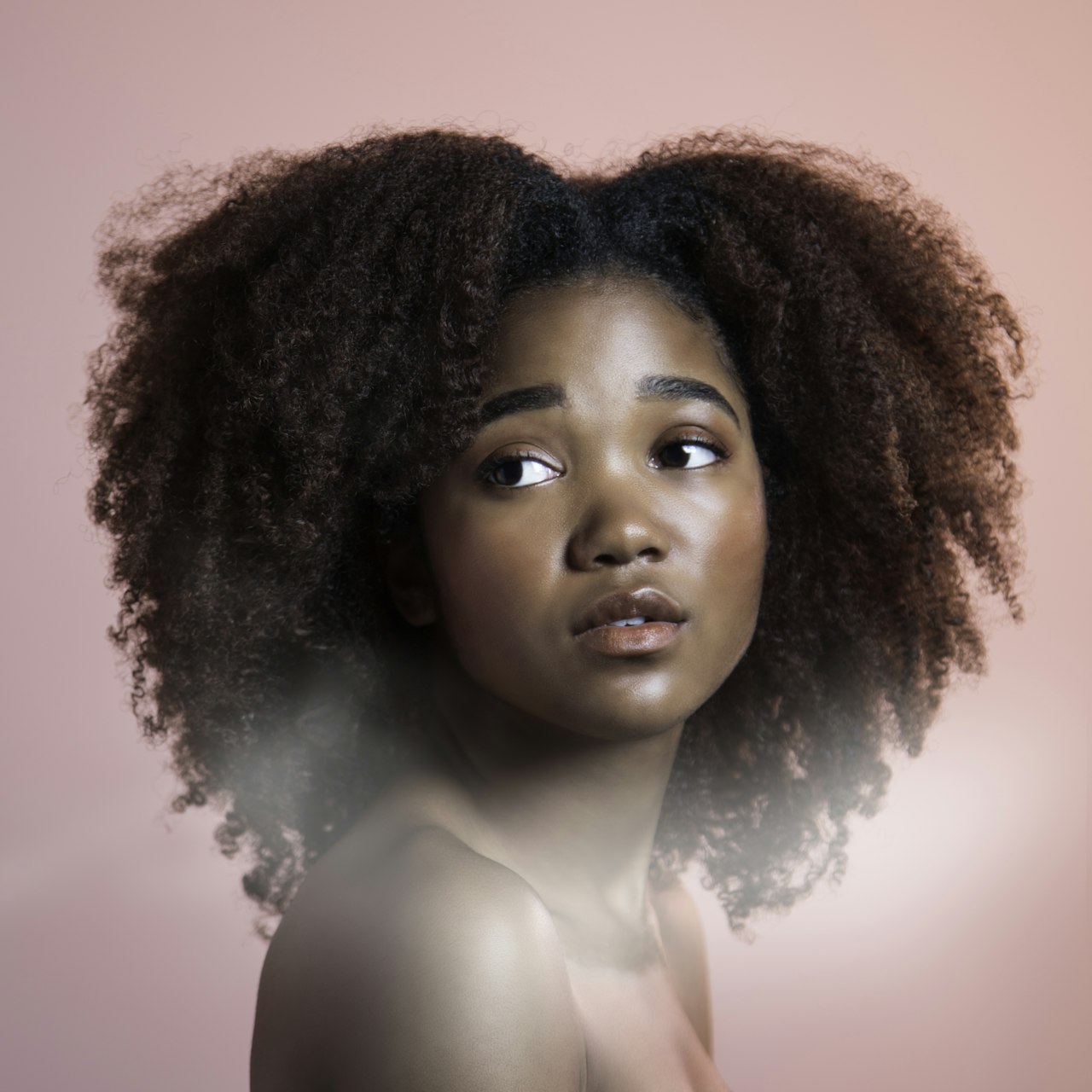
Type 3 hair forms a spiral. When you stretch a wet curl and let go, it springs back instead of hanging as a ribbon. Walker’s chart splits the family by diameter: 3A loops around the width of sidewalk chalk, 3B around a marker, 3C around a pencil or drinking straw. Shine is often still visible because the cuticle follows a relatively smooth helix. Shrinkage is real — 20 to 45 percent is a common range on community charts — but it is usually less extreme than Type 4.
Type 3 is also the family most often sold a thousand gels. Definition is a film plus clumping, not a personality. If your wash-and-go fails, look at porosity, application on soaking hair, and whether you are actually 2C or 4A before you buy another cream. Use identify your hair type if the letter is still a guess.
3A, 3B, and 3C
3A is a loose, shiny spiral. It photographs well, loses clumps if you touch it while drying, and can look wavy at the root. Product should be medium: a curl cream plus a light gel, not a butter. Humidity undefines 3A first because the helix is wide.
3B is the textbook ringlet. Density is often high. These curls drink moisture and still frizz at the halo. Layering a leave-in, a cream, and a gel (the “LOC” or “LGC” idea, liquid then cream then gel) is common. Protein is a maybe, not a default — high-porosity 3B likes it, low-porosity 3B gets stiff.
3C is a tight corkscrew packed close. Volume is huge. Shrinkage jumps. 3C is the subtype people argue about with 4A. The coil on 3C still looks like a spiral in the mirror; 4A looks like a small spring or S-coil when you isolate a strand. If your dry hair is an afro-shaped mass with little visible spiral until you stretch it, read coily hair as well.
The wrap test on the hair type chart is a comparison, not a lab calliper. Wrap one air-dried curl around the object. Neighbours are allowed.
Clumping versus frizz
A curl clump is several fibres drying as one rope. Frizz is fibres that left the rope. You get clumps by applying styler to soaking hair, encouraging strands to find each other (praying hands, then scrunch), and not touching until dry. You lose clumps by towel-roughing, brushing dry Type 3, or using so little product that the cast never forms.
A gel cast is supposed to be crunchy. You scrunch it out when the hair is fully dry. If you never get a cast, the gel is too weak, the hair was too dry when you applied it, or the porosity is so high that the film cracked. That last case belongs on the porosity test page.
Shrinkage is not damage
A 3C curl that looks ear-length dry and shoulder-length wet is doing what a helix does. Stretching every day with heat to “see the length” is how 3C becomes a frizz halo with split ends. If you want length, measure wet or stretched occasionally, and keep mechanical stress for styles you actually wear, not for checking the chart.
Care map for Type 3
- Cleanse the scalp; condition the lengths with a slip-heavy conditioner so you can detangle with fingers or a wide-tooth tool in the shower.
- Apply leave-in and styler on soaking hair, section by section if density is high.
- Dry with a diffuser on low, or air-dry without touching.
- Refresh with water plus a little leftover styler; dry cream on dry curls just sits.
- Trim on a curl-by-curl basis if you care about shape; blunt Type 1 advice does not map.
- For ordered routines, see care by type.
Science sitting under the spiral
Curl correlates with follicle ellipticity and with bilateral structure in the cortex (Robbins, Chemical and Physical Behavior of Human Hair). Type 3 is a marketing bin over that biology. De La Mettrie et al. (2007) would scatter 3A–3C along a curvature continuum. Koch et al. (2020) warn that cosmetic labels and forensic labels are not the same language. This page uses Walker because that is the search query. Mechanism lives on structure and colour if pigment and curl are getting mixed up in your head — they are different genes.
If you arrived from wavy because your ends loop, stay honest about the root. A 2C root with 3A ends is mixed Type 2/3, and the types hub expects you to read both.
Frequently Asked Questions
Quick answers to the most common questions.
How do I tell 3A from 2C?
2C is still an S. 3A is a spiral you can wrap into a loop. Stretch a wet strand: ribbon versus spring is the practical test.
Do I need a gel if I have Type 3 hair?
You need some film if you want clumps to survive humidity. Cream alone often leaves a halo. The gel can be light; it does not have to be a rock-hard rave gel.
Why is my 3C hair so short when it is dry?
Shrinkage. The helix occupies less vertical length. Wet or stretched length is the fairer comparison, not a sign the hair cannot grow.
Is 3C the same as 4A?
No. 3C still reads as a corkscrew in the mirror. 4A is a smaller coil, often with more shrinkage. Read both coily pages if you are on the border.